

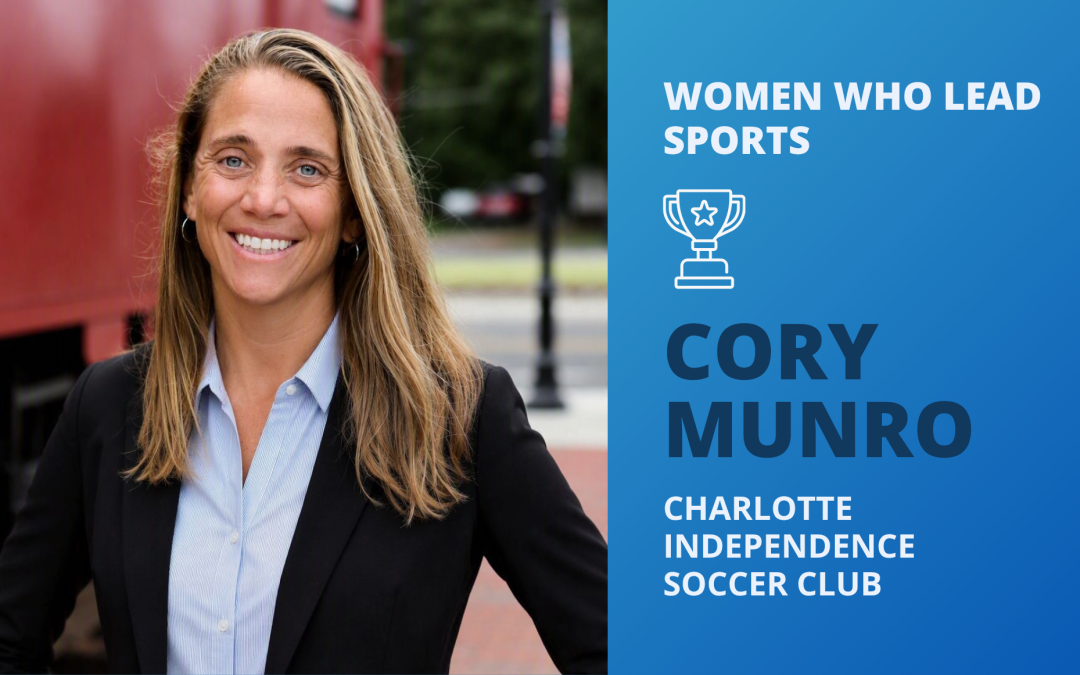
This year, we’re celebrating Brooke Faw as a member of our class of Women Who Lead Sports. Brooke’s journey to the sports Cory Munro started at the Charlotte Independence Soccer Club as a part-time coach. Today she is the club’s Chief Business Officer. The road between those two roles was long and winding, and that is the lesson she most wants to share. We are sharing Cory’s story and honoring her as a member of this year’s class of Women Who Lead Sports.
A Lifetime in the Game
Sports have been part of Cory’s life since she started playing soccer at age four. She also played volleyball, did gymnastics, and tried nearly every other sport available to her. Her career has taken many turns since then, but she has always been drawn back to sports, and to creating for young athletes, new coaches, and families the same experience and opportunities she gained from sports herself.
What she took from those years went well beyond the game: hard work, perseverance, self-confidence, resilience, and the ability to work with all kinds of people. She calls it “the foundation of my whole career.”
A Hard Left
Cory was several years into a career as a college soccer coach when she stepped away to care for a family member who fell ill. While she was doing that, she was diagnosed with cancer.
“My life took a hard left on the path that I thought I was going to follow,” she says.
She survived and was then told she probably wouldn’t be able to have children. But she did, and when they arrived, she chose to stay home and raise them. Neither she nor they had been expected to be here, and she valued that time with them. She had no idea whether sports would ever be part of her life again. The industry keeps moving when you step away, and after years at home she wondered whether she would still be employable.
Getting Back in the Game
Cory, who was already coaching part-time for the Independence, went to the organization and asked whether there was an opportunity to expand her role. She started with about 15 hours a week and treated those hours as an opportunity to prove herself, earn trust, and take on more responsibility. Over the next five years, that part-time role grew into the leadership position she holds today.
“Your career path is not linear. It goes in all these different directions,” she says. “And just because you feel like you’re stepping away doesn’t mean you’re not going to get back on track.”
Today, Cory is working in a sport she loves, in a job she loves, and she counts that as a success.
Building Something That Lasts
As Chief Business Officer, Cory works heavily in financial operations and serves as the link between the club and its accounting firm. She is also heavily involved in programming, strategic decisions, and operations, and after so many years she carries a great deal of knowledge about the organization.
As a coach, Cory found the greatest reward in those moments when something finally clicked for a player, when struggle turned into understanding and confidence. As a leader, she finds the same reward in working with young staff. Most of all, she wants to position the club to succeed long after she is gone. If she plays even a small part in that, she says, she will be happy.
Ambition Without the Spotlight
Asked to define ambition, Cory says, “It’s committing to continuous growth rather than becoming complacent.” To her, that means a drive to keep learning, to improve every day, and to leave things better than she found them.
She has never been motivated by titles or recognition, and she does not like being in the spotlight. What keeps her going is the chance to build an organization or improve someone else’s path.
Remember Why You Started
Cory is a self-described quote person, and one hangs in her house: “When you feel like quitting, remember why you started.”
She has leaned on it as a coach when a team wasn’t clicking, or a player couldn’t break through, and she applies it to professional life too. When she hits a wall, she goes back to basics and reminds herself why she got into the game. Then she steps away for a while and comes back to look at the problem through a different lens.
Owning the Mistake
Cory put herself through college working at Marriott Hotels. She had done every job there and was on a path to become a general manager one day, but it wasn’t what she wanted to do. She kept one lesson from those years, from a manager named Adam, who built his career on hard work and accountability and remains a close friend.
Everyone makes mistakes, he taught her. What matters is how you respond. “If you walk into a room and own that mistake, the accountability and the respect that you build with your peers is immeasurable,” she says. You admit it, you ask how to make it better, and you become part of the solution. It has become a measuring stick for the people she works with.
The Doors Others Opened
Early in Cory’s career, there were few women in the soccer industry for her to look to as role models. She was fortunate, however, to have several male coaches and colleagues who believed in her, advocated for her, and opened doors along the way. She can’t point to just one role model. What those influences shared was that they gave her an opportunity, then trusted her to make the most of it.
“If you open the door for me, you won’t regret opening it,” she says.
A Message to Her Younger Self
Cory’s advice to her younger self is direct: “This is going to be a long and winding road. Buckle up. You have no idea what’s coming.”
“When you’re young,” she says, “you think you have it all mapped out, and then life comes at you from every direction.” Her answer is to remember who you are at your core and stay true to that person. If you do, she believes, everything will work out.
As a Women Who Lead Sports 2026 honoree, Cory offers a quiet but persistent version of ambition: keep learning, own your mistakes, and leave things better than you found them.